
Have you noticed books lately with colorful, patterned, or even illustrated page edges? This seemingly modern trend actually has a long history.
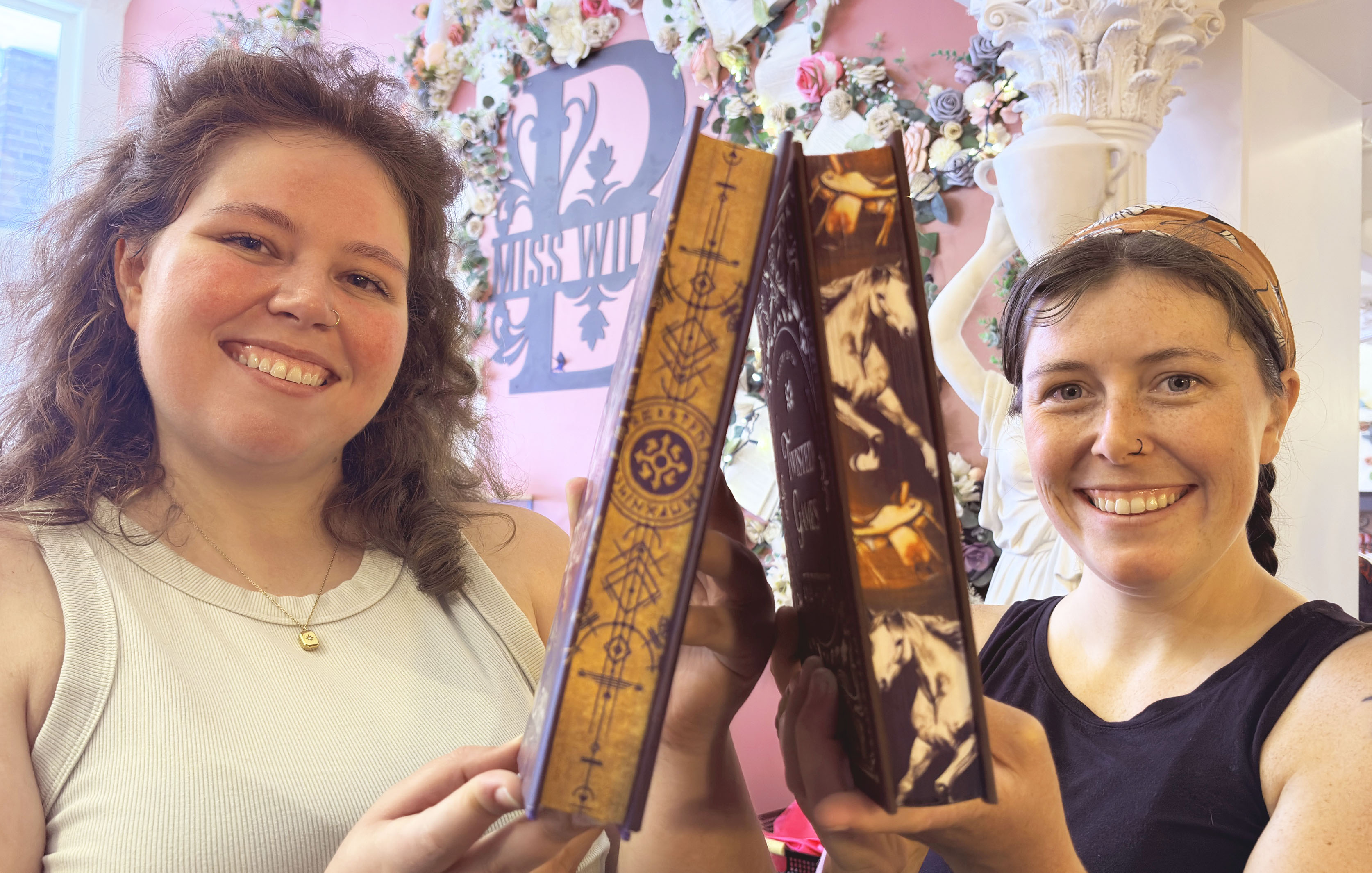
“I love a pretty bookshelf,” said Autumn Morgan, as she pulled a fancy volume with a graphic cover, but also an elaborate design on the edges of the book. Her sister, Mikayla Hansen, also picked one of the fancy volumes.
They were exploring the colorful shelves of Miss Willa’s Bookshop on N. George St. in Charles Town.
“My bookshelf at home is like a bunch of little trophies,” she said.
The sisters had traveled three hours for a local wedding, but made a special trip to the popular bookshop that features a huge collection of books with elaborately decorated sprayed edges, sometimes called “spredges,” which has become very popular with current fantasy fiction.
For centuries, bookbinders decorated the edges of books with ink, paint, gilding, or other designs. In the 17th century, English binders developed an especially clever technique: they could slightly fan the pages, paint a picture across the angled edges, and then close the book. The image disappeared! Only when the reader gently fanned the pages could the hidden landscape, building, or scene be revealed.
The technique became especially fashionable in the late 18th and early 19th centuries. The Edwards Bindery of Halifax, England, became famous for its elaborate fore-edge paintings, turning the humble edge of a book into a tiny work of art.
Today, technology has given the idea a new life. Publishers can mechanically print colored patterns, illustrations, and designs onto the edges of thousands of books very quickly.
There is a wonderful difference between the old and new versions, though. Traditional fore-edge paintings were meant to hide until someone discovered them. Modern decorated edges are meant to catch your eye on a bookstore or library shelf, turning the text block itself into a decorative canvas.
So the next time you pick up a book with decorated page edges, take a closer look. You will be holding a very old idea in a very new form.
And, of course, here at the Charles Town Library, we’re perfectly happy with anything that makes people want to pick up a book and look inside.

Autumn Morgan and Mikayla Hansen lost themselves among the colorful shelves of Miss Willa’s Bookshop on N. George St. in Charles Town, during a recent visit.
These are a selection of Jennifer Armentrout’s books which feature sprayed edges.


