
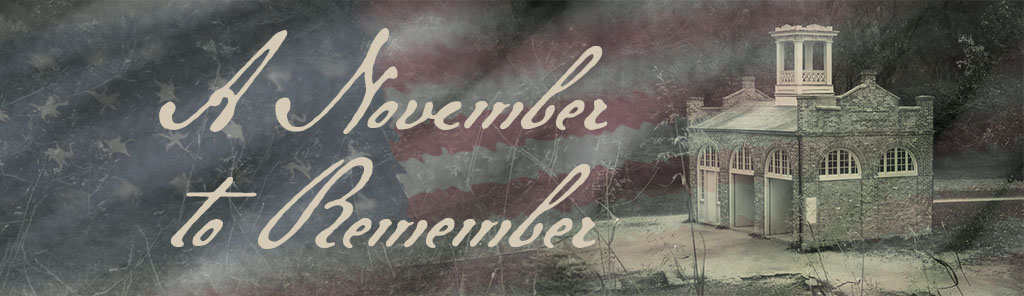
In 1859, Thanksgiving was four years away from being recognized as a national holiday.
At the time, it was more of a New England holiday than a southern celebration and was also rejected in 1856 by Virginia Gov. Henry A. Wise as the “theatrical national claptrap of Thanksgiving.” Wise also complained that Northern ministers were using Thanksgiving sermons to criticize slavery.
In November 1859, the Governor was facing a much more serious situation than abolitionist preachers. After a raid that triggered the arrival of federal troops in Harpers Ferry, John Brown, now both famous and infamous, sat in his cell in the then-Charlestown jail, having lit a spark that would erupt across the country two years later.
But also in 1859, less than 80 miles to the east in Alexandria, the mayor, William D. Massey, proclaimed Nov. 24 as a Day of Thanksgiving, “that all places of business be closed, and the Rev. clergy have Divine service in their various houses of worship, at some suitable hour during the day.”
However, Gov. Wise’s thought that the holiday was being used by Northern churches as an opportunity to promote abolition seems to be true. In John Brown’s November 28, 1850 letter to his wife while he was in Springfield, Massachusetts, he said, “I of course keep encouraging my colored friends to “trust in God, and keep their powder dry.” I did so to-day, at Thanksgiving meeting, publicly. . . .”
In Brown’s existing letters and news stories while he was jailed in Charles Town, there is no mention of the holiday that would eventually be signed into law by Abraham Lincoln.
Brown wrote letters, spoke with visitors and argued unwaveringly in his beliefs that led him to the jail cell, then the wagon and finally to the gallows on a farm only a few hundred yards away.
Also in November of that year, another person who would be forever connected with Brown and Lincoln, was also practicing a talent other than the one he would use in Ford’s Theater in 1865.
John Wilkes Booth, a member of a famous family of actors had arrived in town as a temporary member of the Richmond Grays, a prominent volunteer militia company.
Booth reportedly managed to buy or borrow a Grays uniform so he could travel to Charles Town to participate in securing the area around the gallows where Brown was hanged.
According to letters from the time, Booth performed select scenes from Shakespeare during his stay in town, for the troops and at the Zion Episcopal Reading Room, which is still at the corner of Lawrence and Liberty streets.
Also, Booth’s sister, Asia Booth Clarke, wrote that while he disagreed with John Brown’s abolitionist activity, he admired his tenacity.
John Brown’s time in Charles Town ended with his hanging on Dec. 2, 1859. His body was placed in the wagon and taken to the train station where it was met by his wife in Harpers Ferry, who traveled with it to New York where he is buried.
That November would be followed by more turmoil in Jefferson County and the entire country for the next several years as soldiers battled their way through what was then Virginia and then West Virginia, leaving echoes that can still be felt today.
In 1863, as the war continued to rage, Abraham Lincoln signed the proclamation establishing Thanksgiving as a national holiday. Written by Secretary of State William H. Seward, it says in part, “It has seemed to me fit and proper that they (the extraordinary blessings and deliverances Lincoln described as gifts from God)should be solemnly, reverently and gratefully acknowledged as with one heart and one voice by the whole American People. I do therefore invite my fellow citizens in every part of the United States, and also those who are at sea and those who are sojourning in foreign lands, to set apart and observe the last Thursday of November next, as a day of Thanksgiving and Praise to our beneficent Father who dwelleth in the Heavens.”

An illustration made during the John Brown trial.

A photograph purported to show John Wilkes Booth in a Richmond Grays uniform

Gov. Henry A. Wise, of Virginia